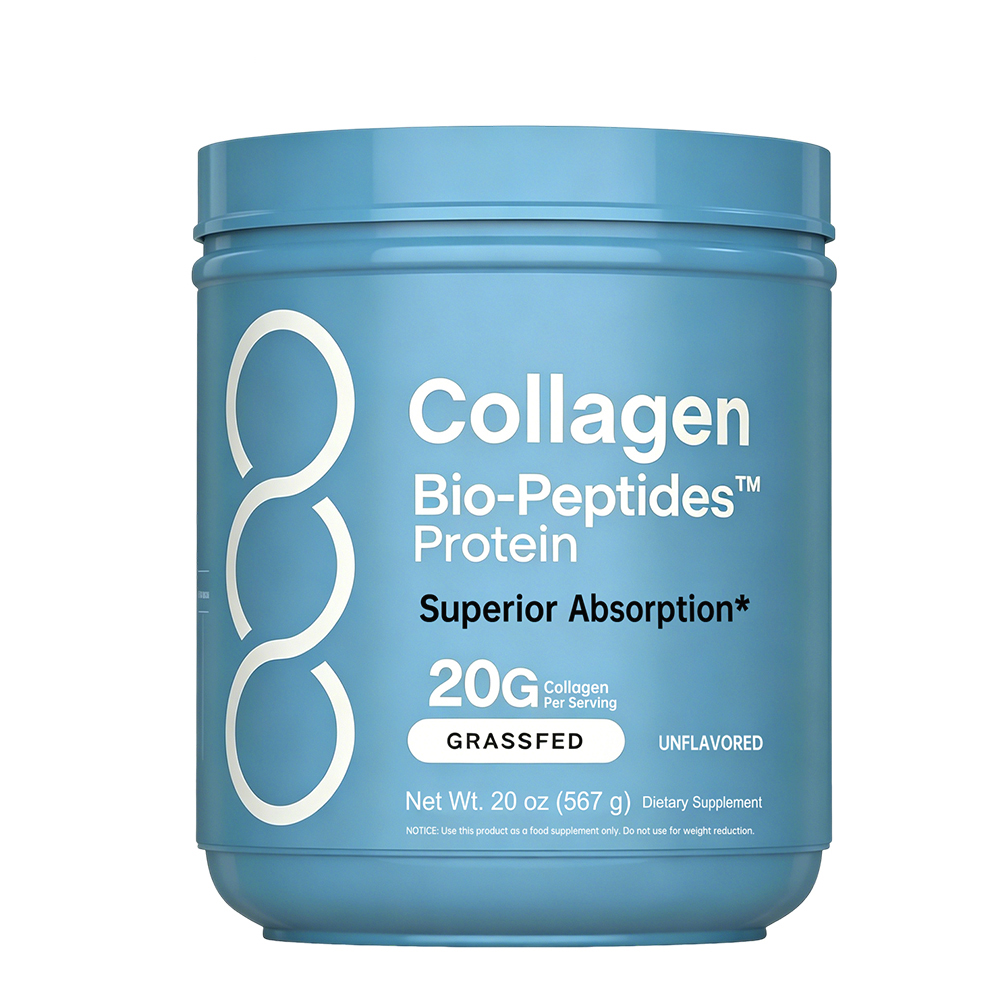
What is grass-fed collagen peptide powder?Why B2B procurement needs to first understand the differences in raw material sources
The core differences between grass-fed and grain-fed collagen peptide powder
The difference between grass-fed and grain-fed is essentially not a "difference in processing," but ratherdifferences in the cattle's growth environment and feed structure, which directly carries over to raw material quality and the market positioning of the final product.
| Comparison dimension | Grass-fed | Grain-fed |
|---|---|---|
| Feed source | Mainly pasture-based, with cattle raised on natural pastures | Mainly corn, soybeans, and other grains, mostly raised in feedlots |
| Farming cycle | Usually longer, with cattle growing naturally | Shorter, with high slaughter efficiency |
| Raw material cost | Higher | Lower |
| End-product positioning | Premium, natural, sustainable | Mainstream, cost-effective |
For B2B procurement, the practical significance of this distinction lies in the following:The procurement cost of grass-fed raw materials is higher, but the corresponding product premium space is also greater.。 If your downstream customers are beauty brands, high-end gyms, or importers, the grass-fed concept itself is a selling point;If your target market is price-sensitive channels, collagen peptide powder from grain-fed or conventional sources may better match your cost budget.
It is particularly important to note that currently "grass-fed" has no unified mandatory certification standard in the Chinese market, and different suppliers may define "grass-fed" inconsistently. Some mean "purely grass-fed," while others mean "primarily grass-fed with a small amount of grain supplementation." When purchasing, you cannot rely solely on the "Grass-fed" wording on the packaging; you must require suppliers to clarify the feeding method of the source cattle, the pasture source, and traceability documents—this is the first step in subsequently verifying authenticity.
Product Positioning and Basic Characteristics of Collagen Peptide Powder (Bioactive Peptides)
Collagen peptide powder (bioactive peptides) belongs toraw materials for oral beauty/nutritional supplementsThe core logic is: the large-molecule collagen in animal skin and bones is broken down into small-molecule peptide segments through enzymatic hydrolysis technology, making it easier for the human body to absorb, and then supplied in powder form for terminal brands to fill or sell directly.
Taking the product currently under discussion as an example, its basic positioning is:
- Raw material source: Grass-fed bovine source, emphasizing natural grazing and sustainable farming
- Product form: Powder, 22 ounces (approximately 624 grams) per can
- Claimed benefit direction: Hair care, skin care, nail care
- Target customers: beauty brands, importers, high-end gyms, corporate welfare procurement
Here is a common pitfall in B2B procurement:treating "collagen peptide powder" as a standardized product for price comparison。 In reality, peptide powder from different suppliers varies greatly in molecular weight distribution, purity, solubility, heavy metal residues, and flavor-masking treatment, and these indicators directly affect the taste and stability of the end product. Grass-fed is only one dimension and cannot replace the examination of the product's own quality.
Section summary: The essence of grass-fed collagen peptide powder is "collagen peptide powder with a differentiated raw material source." It is suitable for B2B scenarios where downstream customers are willing to pay for the concept of "natural, sustainable, high quality";If your procurement decision is mainly based on unit price and supply stability, grass-fed may not be a necessary option. The next step to confirm is: do your target customers recognize the grass-fed premium?
And can the supplier provide traceability proof of grass-fed origin and third-party test reports?
How can B2B procurement verify the authenticity of grass-fed collagen peptide powder? Four-step verification method
The biggest difference between B2B procurement and consumer personal use is: what you buy is not just a can of powder, but a supply chain commitment. The words "grass-fed" in grass-fed collagen peptide powder directly determine raw material cost and product positioning. If it cannot be verified, what you receive may simply be ordinary grain-fed collagen in new packaging. The following four steps, each corresponding to an executable verification action.
Step 1: Verify raw material sources and traceability documents
"Grass-fed" is not a vague marketing term; it corresponds to the way cattle are raised—eating only grass and pasture forage, rather than being grain-fed. What the buyer needs is not just a statement that "we use grass-fed cattle," but a document chain that supports this claim.
You need to request and verify the following documents from the supplier:
- Certificate of origin of raw materials: Clearly indicating the cattle breed and the country/region where the farm is located.Countries with relatively mature grass-fed certification systems (such as Australia and New Zealand) usually have certificates of origin endorsed by the government or industry associations.
- Batch records for slaughter and processing: Full-chain records from pasture to processing plant, including transportation, slaughter date, and processing batch number.This record should correspond to the specific batch you purchased, rather than a vague "annual report."
- The supplier's raw material procurement contract or upstream proof: If the supplier is not a rancher but an intermediary, require them to provide a procurement contract or long-term cooperation agreement with the ranch to confirm that the raw material source is stable and traceable.
Key trade-offs: The completeness of traceability documents directly reflects the supplier's supply chain management capability. If the other party can only provide the words "grass-fed" on a brochure and cannot produce any documents corresponding to the batch, this itself is the biggest risk signal.
Step 2: Review the key indicators in the third-party test report
The issue with a test report is not whether one exists, but what is written on the report. A qualified third-party test report should be issued by a laboratory with CNAS or CMA accreditation, and the sample information on the report should correspond to your procurement batch.
After receiving the test report, focus on three indicators:
| Indicator | What to look at | Why it matters |
|---|---|---|
| Hydroxyproline content | Generally should be ≥10% (calculated on a dry basis) | Hydroxyproline is a characteristic amino acid of collagen; if the content is too low, it indicates that the product may be adulterated with gelatin or protein powder |
| Heavy metals (lead, arsenic, cadmium, mercury) | Each individual item must be below the national standard limit | If grass-fed raw materials come from natural pastures, the heavy metal risk is usually lower, but it must be confirmed with data |
| Microbiological indicators | Total aerobic plate count, coliforms, Salmonella | Directly related to food safety; B2B procurement must require testing for each batch or each quarter |
Practical Methods for Purity Assessment: In addition to checking the hydroxyproline content, you can also look at the "protein content" and "ash content" in the report. Excessively high ash content (over 2%) may indicate mineral addition or impure raw materials. If the report only contains vague statements such as "protein ≥90%" without hydroxyproline and ash data, the verification value of that report is greatly reduced.
Step 3: Confirm the evidence distinguishing "grass-fed" from "grain-fed"
This step is easily overlooked, but it is precisely where B2B procurement is most prone to pitfalls. The raw material cost difference between ordinary collagen peptide powder and grass-fed collagen peptide powder is significant, and some suppliers play tricks with the raw materials—for example, using extract from grain-fed cattle while labeling the packaging as "grass-fed."
Verification methodsGrass-fed beef and dairy products already have well-established isotope testing methods (distinguishing feed types by carbon-13 and nitrogen-15 isotope ratios), but isotope testing of collagen peptide powder is not an industry standard. Therefore, a more pragmatic approach is:
- Require the supplier to clearly define "grass-fed" and specify breach clauses in the contract, for example, "source cattle are fed only pasture grass and hay, with no grain feed added"
- Require the supplier to provide feeding records or certifications from upstream pastures (such as Certified Grassfed, PCO Certified Organic and other international certifications)
- If the supplier cannot provide any of the above, it is recommended to first place a small trial order and observe the product's color, odor, and solubility—collagen peptide powder from grass-fed sources is usually slightly beige in color and has a milder odor, but this is only auxiliary judgment and cannot replace documentary evidence
Step 4: Write verification actions into the procurement contract
The previous three steps are "checking"; this step is "locking." Verification in B2B procurement cannot stop at verbal confirmation; it must be translated into contract clauses:
- Batch correspondence clause: It is agreed that each batch of arrival must be accompanied by the third-party test report and raw material traceability documents corresponding to that batch
- Sampling inspection right clause: It is agreed that the purchaser has the right to send any batch to a third-party laboratory for re-inspection, and the cost shall be borne by the supplier (if the test results are unqualified)
- Liability for breach of contract clause: It is clearly stipulated that if the raw materials are found not to be of grass-fed origin, the supplier shall bear the consequences of return, compensation, and contract termination
Judgment of suitability and unsuitability: If your brand is positioned in high-end oral beauty or health food, the traceability verification of grass-fed collagen peptide powder is worth investing time and contract costs;If you only need a basic collagen raw material and have no clear marketing need for the "grass-fed" concept, then ordinary collagen peptide powder paired with a standard test report may offer better cost-effectiveness—the key depends on whether your end consumers are willing to pay for the "grass-fed" differentiator.
Next-step confirmation actions: Request from the current website team the raw material origin certificate and the third-party test report for the most recent batch of this collagen peptide powder (bioactive peptides), focusing on verifying the hydroxyproline content and heavy metal data, and confirm whether the batch number on the report matches the sample.
What certifications are required for grass-fed collagen peptide powder?How buyers can verify the validity of certifications
When purchasing grass-fed collagen peptide powder, certifications are the first filter for judging the authenticity of raw materials, but it is necessary to distinguish which are hard requirements, which are bonus points, and how to verify that certifications are not just decoration on the packaging.
Common certification types and verification channels
The certifications potentially involved in grass-fed collagen peptide powder fall roughly into three categories:
Raw material certification (the most essential)
- Grass-fed certification: Such as the USDA grass-fed certification or the grass-fed standards of third-party organizations (such as AWA, Certified Grassfed), which directly prove the raising method of the cattle.
- Organic certification: Such as USDA Organic or EU organic certification.Note: Organic does not equal grass-fed; the two cover different dimensions and cannot substitute for each other.
Processing and quality certification
- Non-GMO certification: Proves that no genetically modified ingredients are used in the raw materials and processing, which is a quality bonus point.
- HALAL or KOSHER certification: When downstream customers have religious dietary requirements, these two are hard thresholds.
Safety and traceability certification
- HACCP or ISO 22000: Proves that the production factory has a food safety management system, which is a basic threshold.
- Third-party testing reports: Such as batch testing reports for heavy metals, microorganisms, and pesticide residues.Strictly speaking, this is not a "certification," but its practical value is often higher than a certification certificate.
Verification channels: After obtaining the certification number, go to the official website query system of the corresponding certification body and enter the number to verify. USDA organic certification can be searched in its official website database, and the certification number of the Non-GMO Project can also be verified on its official website. This step cannot be skipped—some certification marks on packaging may only be "reference styles" and have not actually been authorized.
Limitations of certification verification: certification ≠ greater certainty of quality
Certification can prove "compliance with a certain set of standards," but it cannot prove "this batch of goods is good." Buyers need to note two points:
First, certification is static, while products are dynamic. A grass-fed certification may cover a raw material batch from three years ago; whether the current batch comes from a ranch under the same certification system requires checking the accompanyingbatch traceability documents. Only when the certification certificate, the test report for the current batch, and the quality clauses in the procurement contract are aligned can it be considered a complete chain of evidence.
Second, certification only covers the scope it declares to cover. Grass-fed certification does not provide greater assurance regarding the molecular weight distribution or degree of hydrolysis of peptide powder;organic certification does not provide greater assurance that heavy metal content meets standards. These are product specification issues, and one needs to look at the specific indicators in the COA (Certificate of Analysis), not at the certification label.
Suggested action: Request three documents from the supplier—① Grass-fed certification certificate and number (for verification on the official website);② COA test report for the most recent batch (focus on heavy metals and microbiological indicators);③ Raw material source traceability statement (clearly specifying the proportion of grass-fed raw materials). Only when the three documents align can the certification verification step be considered solid.
How to evaluate grass-fed collagen peptide powder suppliers?A complete judgment from qualifications to suitability
When purchasing grass-fed collagen peptide powder, the difficulty is not "which company to choose," but "how to verify that what they say is true." The grass-fed concept has been used extensively in recent years, but the evidence that can actually be put on paper is less than one might imagine. The following presents a judgment framework in decision order.
Five key dimensions for supplier qualification assessment
First, whether raw material traceability forms a closed loop. This is the core of grass-fed certification. A qualified supplier should be able to clearly state which country and which ranch the cattle come from, what the grass-fed ratio is, and the processing chain from slaughter to hydrolysis.
If the other party can only give a vague statement such as "imported from New Zealand/Australia" and cannot provide specific information about the ranch or processing plant, the traceability chain is broken. What you need to obtain is verifiable documentation, not sales talk.
Second, what items does the test report cover? The key focus of testing collagen peptide powder is not "whether it contains collagen," but three things: heavy metal residues (especially lead, arsenic, and mercury), microbiological indicators, and molecular weight distribution. Among these, molecular weight distribution directly determines absorption efficacy, but many suppliers only provide protein content and avoid molecular weight data.
If the other party cannot produce a complete report from a third-party laboratory, or if the report does not clearly indicate the testing method and batch number, the credibility of that report should be discounted.
Third, is there evidence to support the distinction between grass-fed and grain-fed? The core difference between grass-fed and grain-fed lies in fatty acid composition and feeding methods, but after the finished peptide powder undergoes hydrolysis, many of the original characteristics are altered. If the supplier cannot provide grass-fed proof at the raw material stage (such as pasture certification or feed records), it is difficult to verify the authenticity of "grass-fed" based solely on a finished product test report.
On this point, the other party needs to clearly explain the verification path, rather than just saying "we are more confident it is grass-fed."
Fourth, batch stability and supply capability. Collagen peptide powder is a batch-based product, and there may be slight differences in color, odor, and solubility between different batches. Whether the supplier has a fixed raw material source, whether it keeps batch retention samples, and whether it can provide testing data for consecutive batches determine whether the product is stable during your long-term procurement.
If the other party can only provide sample data for a single batch, quality may fluctuate during subsequent bulk supply.
Fifth, cooperation transparency and response speed. This may not sound like a hard metric, but it is crucial in actual procurement. Whether the supplier is willing to provide complete qualification documents, whether it accepts your factory audit, and whether its answers to technical questions are specific directly reflect its confidence.
If the other party is vague on key issues and only pushes for orders, it will most likely also be difficult to cooperate with when quality disputes arise later.
When to choose this product and when it is not recommended
Scenarios suitable for choosing grass-fed collagen peptide powder (bioactive peptides):
- Beauty brands using it as an oral beauty raw material: The product is positioned in the mid-to-high-end segment, the grass-fed concept can support brand premium, and the 22-ounce specification is suitable as the raw material for a core SKU.
- Importers looking for differentiated products: Ordinary collagen peptide powder faces fierce competition, while the grass-fed + bioactive peptide positioning offers differentiation and is suitable for entering specific channels.
- High-end gyms or health management institutions: Aimed at quality-focused members, the selling point of grass-fed protein matches the customer group's perception.
- Corporate gifts or employee benefits: The product packaging specifications and positioning are suitable as health gifts, and recipients are more sensitive to quality than to price.
Scenarios where it is not recommended to choose:
- Procurement with budget priority and pursuit of the lowest unit price: The cost of grass-fed raw materials is significantly higher than that of grain-fed. If the end pricing cannot support it, it is not recommended to force the choice of grass-fed; ordinary collagen peptide powder is a better match.
- Unclear target audience and vague efficacy expectations: If the buyer themselves cannot clearly state who it is sold to and what problem it solves, do not decide on the product yet.Grass-fed is a quality upgrade, not a change in efficacy, and it cannot solve the problem of unclear positioning.
- Need to quickly validate the market and test the waters with small batches: If it is only exploratory purchasing, the minimum order quantity and unit price of grass-fed products may not be suitable for small-scale testing; confirm the supplier's minimum order quantity first before deciding.
Recommended budget allocation priorities: Quality verification (test reports, traceability documents) > raw material source (grass-fed certification) > packaging specifications > price negotiation. Do not skip the testing step just to lower the unit price—the loss caused by a batch of non-compliant raw materials is far greater than the price difference saved. For long-term cooperation, you can negotiate discounts based on volume, but this should not come at the expense of testing frequency.
Frequently Asked Questions
Q: Is there really a difference in efficacy between grass-fed collagen peptide powder and regular collagen peptide powder? Answer: Based on the available product information, the core difference of grass-fed lies in raw material quality and rearing methods, not in the efficacy mechanism of the peptide powder itself. If what you care about is "absorption effect," molecular weight and peptide chain distribution are more critical than whether it is grass-fed or not;if what you care about is "raw material quality and brand story," then grass-fed has practical significance.
Before purchasing, you should confirm whether the supplier can provide molecular weight testing data, which demonstrates product strength better than a grass-fed label.
Question: How can you verify that a supplier's claim of "grass-fed" is true? Answer: Ask them to provide grass-fed proof at the raw material end, including pasture certification, feed records, or raw material batch traceability sheets. If they can only provide finished product test reports and cannot explain how grass-fed is verified, it is recommended to have the current website team assist in confirming their raw material sources and verification path before deciding whether to proceed.
Question: Which indicators should be examined in a test report? Answer: At least three items should be covered: heavy metal residues (lead, arsenic, mercury), microbiological indicators (total colony count, E. coli, etc.), and molecular weight distribution. The report must indicate the testing method, batch number, and the name of the third-party institution.
If the other party only provides protein content, that is not sufficient to judge product quality.
Question: What scale of purchasing is the 22-ounce packaging suitable for? Answer: 22 ounces is approximately 623 grams, suitable as a retail single item or for small-batch trials. If the purchase volume is large, you need to confirm whether the supplier has larger packaging options and whether different specifications affect the unit price.
It is recommended to first clarify your monthly usage, then check with the current website team whether the packaging and minimum order quantity match.
Question: If the budget is limited, which part should be cut first? Answer: It is not recommended to cut the testing and traceability steps. If the budget is tight, you can prioritize a smaller minimum order quantity or simplified packaging, but do not skip quality verification.
The premium price of grass-fed products itself includes quality costs. If the budget cannot cover the verification steps, it means the product may not be suitable for the current procurement stage.
Learn more
If you are evaluating procurement options for grass-fed collagen peptide powder (bioactive peptides), you are welcome to submit your target usage, desired specifications, and quality requirements to our team. We will help you check the raw material traceability documents, test reports, and certification information, and match you with a suitable supply plan.
Related products:Collagen peptide powder (bioactive peptides)